Telegram Marketing vs. WhatsApp Business: Why High-Growth Brands are Migrating to Telegram
In the competitive landscape of 2026, the battle for digital attention has moved from open social feeds into the “dark social” of messaging applications. For high-growth organizations, the choice of platform is no longer a matter of personal preference but a critical business decision that impacts scalability, automation costs, and conversion efficiency. While WhatsApp Business remains a dominant force for individual peer-to-peer communication, a significant migration is occurring toward telegram marketing for brands that prioritize community-led growth and sophisticated automation. Understanding the architectural differences between these two ecosystems is essential for any telegram marketing agency or brand looking to optimize its 2026 acquisition strategy.
The Architectural Divide: Cloud-Based Flexibility vs. Device-Locked Constraints
The primary driver behind the migration to telegram marketing is the fundamental difference in infrastructure. WhatsApp’s architecture is historically rooted in mobile-first, device-paired connectivity. Even with recent updates to its multi-device functionality, the platform still faces limitations regarding synchronization speed and the need for a primary device to remain active. This creates a bottleneck for teams that require simultaneous, high-velocity access across multiple workstations.
Conversely, Telegram’s natively cloud-based architecture allows for seamless, real-time synchronization across an unlimited number of devices. For a professional telegram marketing services provider, this means that a distributed team of agents, content creators, and community managers can manage a single brand presence without the friction of device-pairing or message delays. This infrastructure also enables Telegram to handle file sizes of up to 4GB, dwarfing WhatsApp’s limits and allowing for the distribution of high-definition video assets and massive data sets directly within the chat interface.
Scaling Without Boundaries: Unlimited Reach and Group Dynamics
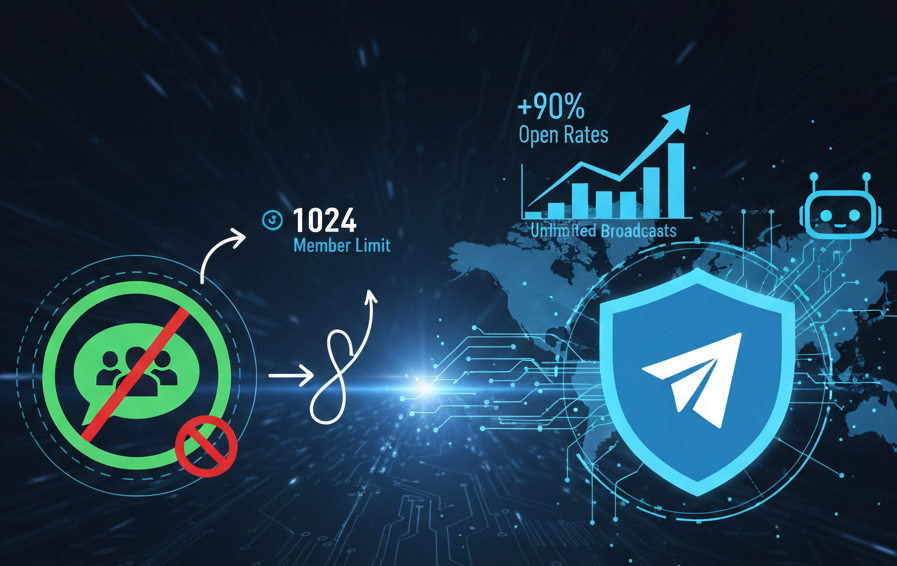
When evaluating telegram channel marketing against WhatsApp’s “Communities” or “Broadcast Lists,” the disparity in scalability becomes immediately apparent. WhatsApp continues to enforce strict caps on group sizes (currently limited to 1,024 members) and broadcast recipients (256 for non-API users). Even with the WhatsApp Business API, businesses are subjected to per-conversation fees and a rigid “Template” approval process that can slow down real-time marketing initiatives.
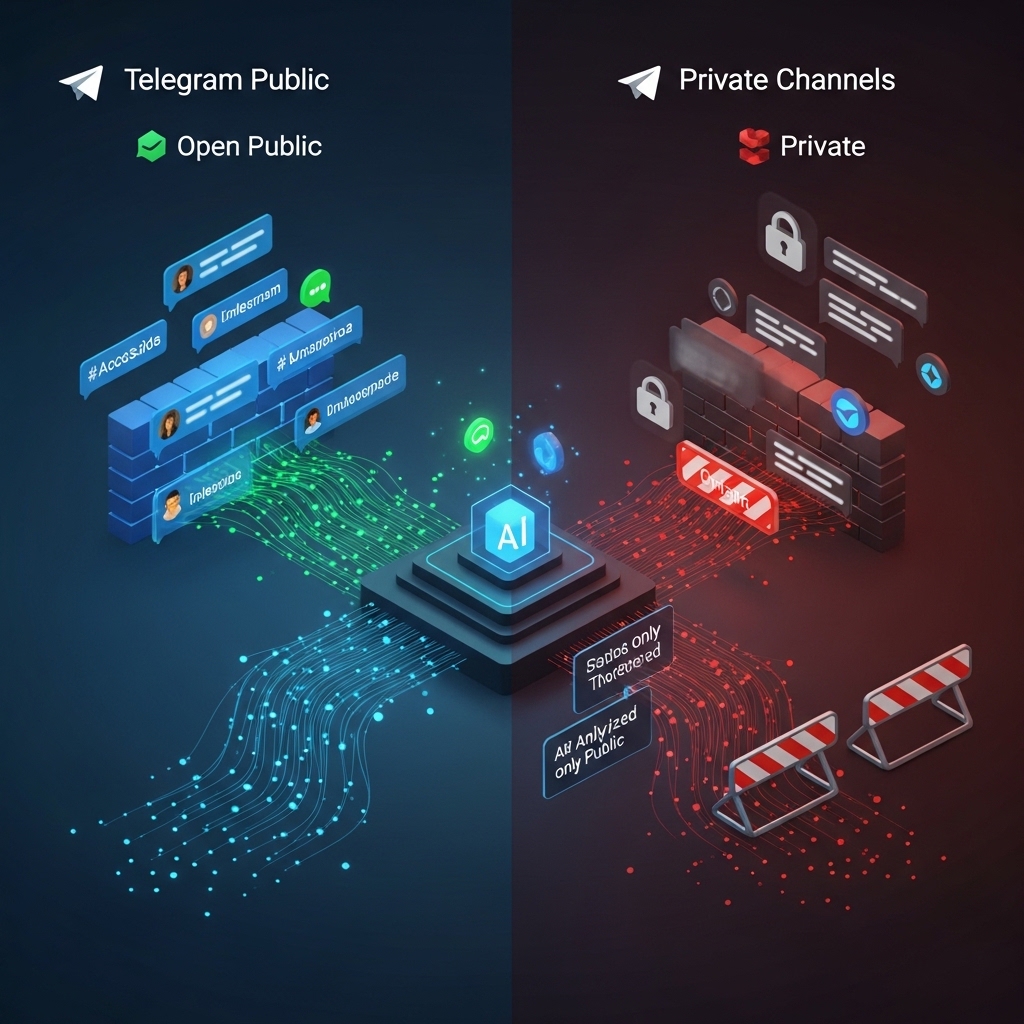
Telegram removes these barriers entirely. A single Telegram channel can host an unlimited number of subscribers, while “Supergroups” can accommodate up to 200,000 members. This makes telegram marketing the superior choice for building massive, interactive brand ecosystems. Furthermore, Telegram’s searchability is a core advantage; public channels are discoverable via the app’s internal global search and external search engine indexes. Unlike WhatsApp, where a brand must already have the user’s phone number or provide a direct link, Telegram allows for organic discovery, effectively functioning as a search-driven social network.
The Automation Advantage: Bot API Freedom vs. Restricted Workflows
Automation is where the gap between a standard digital marketing company and a specialized telegram marketing agency is most visible. The WhatsApp Business API is a gated ecosystem that requires third-party Business Solution Providers (BSPs), mandatory business verification, and pre-approval for any message sent outside a 24-hour service window. While this “walled garden” approach offers high deliverability, it often stifles innovation and dramatically increases the operational cost of scaling a campaign.
Telegram’s Bot API is completely open, free, and requires no prior approval. Using TG Tool, brands can deploy sophisticated AI agents, automated sales funnels, and interactive Mini Apps that launch instantly. This “Developer-First” philosophy allows for a level of customization that is impossible on WhatsApp. From automated “Tap-to-Earn” referral programs to real-time crypto payment integrations via the TON blockchain, telegram marketing services offer a playground for high-growth brands to experiment with frictionless social commerce. In the YMYL sectors of Fintech and iGaming, this agility is the difference between a high-converting campaign and a stagnant broadcast.
Privacy-First Identity and Trust in 2026
Privacy has become a primary currency in the 2026 digital economy. WhatsApp’s requirement for a phone number to be visible to all parties in a chat is increasingly viewed as a friction point for privacy-conscious users. Meta’s data-sharing policies across its ecosystem also remain a point of contention for users who value identity masking.
Telegram provides a superior “Trust Architecture” by allowing users to hide their phone numbers entirely, utilizing public usernames instead. This anonymity encourages higher engagement in public communities and niche groups. From an E-E-A-T perspective, the ability to build a verified, authoritative channel without demanding sensitive personal data from the user builds a unique form of “Transactional Trust.” For a telegram marketing agency, this means higher opt-in rates and lower resistance during the initial phases of the customer journey.
Strategic Selection: When to Choose TG Tool for Global Growth
Choosing between platforms is ultimately a question of business objectives. WhatsApp is a powerful tool for localized customer support and “last-mile” sales in regions with high market penetration. However, for brands that require unlimited scalability, advanced bot-driven automation, and an integrated social commerce experience, telegram marketing is the definitive choice for 2026.
TG Tool provides the enterprise-level infrastructure needed to manage this complexity. By centralizing channel management, member analytics, and automated response logic, it turns the open flexibility of Telegram into a disciplined growth engine. As the digital landscape continues to move toward decentralized, community-driven commerce, the migration toward Telegram is not just a trend—it is a strategic necessity for brands that refuse to be limited by legacy messaging constraints.